

The line is too long. It’s taking forever to get out of the shopping district. I paid to go through the security line and entered the district two hours ago. I bought a new outfit for today. It cost twenty-one Satoshis, which is ludicrous. I only had twenty-five Satoshis left. That still leaves me with a few to pay for the security gate to get out. Not like I’ll need the rest of it anyway.
So here I am, still waiting in the out-gate line. I don’t know what the holdup is. These things are entirely automated. You just swipe your wrist to pay and walk through. If it buzzes, then some robot pushes you to the side to be scanned further—or hauled off to prison. I didn’t steal anything. Nobody else in this place stole anything. So why is everything moving so slow?
Step. bzzzddttt
I’m trying to go to the green. I made plans to go today. I can barely see it through the gates, but I’ll still be in this line a while. I round a corner and step to the first scanner. I swipe my wrist—minus one Satoshi—and step through. No sound for me. Good. I turn another corner and see the rest of the line queueing for the MRI machine. Great. At least I can see the field now.
I look across the green field. Adults jogging, kids riding bikes, kids playing with soccer balls. Everybody seems to be having such a good time with their families. I want to be like them. They look so happy. But I can’t afford to have children.
Step. bzzzddttt
The field is so green it stings my eyes. I haven’t seen grass in a long time. At first I thought it was beautiful, but the more I stare at it, the more I see that it’s just flat—the same color, the same length, no variation. Endless sameness. But there’s so much of it.
Where I live, in the outer ring, there’s no grass. The houses are on top of one another, next to each other, leaving scant ground. Foot traffic wears everything down to dirt. Grass, I hear, is tenacious, but not under relentless abuse. The only other place I’ve seen green like this is at the farms.
Step. bzzzddttt
When I was a child, my dad took me and my sister to see the farms at the outer edge of the city. I stood there in awe. In all directions were green hills. Dad explained they were crops and groves of different vegetables.
Robots went about their business, fertilizing, killing anything that didn’t belong there—like weeds—and harvesting the spoils. He said the entire city was surrounded by farmland, but it wasn’t for us ring folk. That we were never to go into the fields. That they were private property.
Step. bzzzddttt
The only public property is in the outer ring, where my house is. That’s where everyone who doesn’t live in the city stays. All land outside the city is privately owned. There are many cities, but nearly everywhere else belongs to a corporation or an individual richer and more powerful than any corporation.
Of course, you can’t go to any of those places. Trespassing carries the penalty of death. A landowner is well within their rights to kill anyone who steps on their land. Since all the land is private—even the roads out of here—it’s a death sentence just to walk anywhere outside the ring unless you can afford the tolls.
I could never afford to go down those roads, so I stay in the ring.
Step. bzzzddttt
Finally, I get to go through the last scanner. I swipe my wrist—minus one Satoshi—and walk through. I’m clear. The green is before me. But first I have to cross the mall. Kids play on the concrete in dirty shoes, kicking around duct-tape soccer balls. A bunch of these kids are fighting over a ball.
“It’s mine. Give it back!”
They’re fighting over something that shouldn’t be fought over—it’s pointless. One of the kids shouts, “Go touch grass!” The other kid yells back, “I’m not! You’re crazy. You go touch grass!”
They start fighting, punching, hitting. I walk past them. One more step toward the field.
Step. bzzzddttt
A personal transport drone lands in the field in front of me. A family steps out in puffer jackets, smiling, ready to enjoy their day on the green. If you can afford a drone, you don’t need toll roads. You can fly over anyone’s land to get to your own. So far, they haven’t made it so people can own the air. But I’m sure they’ll think of something for that soon.
Another drone takes off. I follow its path, looking at the tops of buildings scraping the clouds. The ring doesn’t have tall buildings like the center spire. Any time we try to build too high with handmade bricks, they collapse in on themselves. These machine-made skyscrapers have rooftop landing zones for drones.
The only time the rich people who live in the towers come to the ground is to touch grass. They’ve never bothered to haul dirt up to the roofs of their metal palaces because they want us to see them touching grass. If there’s no one to envy them, what’s the point?
Step. bzzzddttt
When they first brought in machines to automate jobs, I rejoiced. I thought it was supposed to make things easier for everyone. No one had to do jobs that no one wanted anymore. No one had to clean toilets. No one had to flip burgers. The machines did it all.
They did it faster and better than humans, all day, nonstop. They didn’t need sleep. They didn’t need to eat. Electricity was cheap. It was supposed to leave the rest of us with time to pursue art, music, writing, drawing. But they put a price tag on that too.
Step. bzzzddttt
When they started building their towers, I said, “Good for them. They should be able to enjoy the benefits of hard work. They earned their billions of Satoshis, so they should get to use them.” I thought I could be like them. I was told that if I worked hard enough, I too could have billions of Satoshis. That was the dream I was sold, and I bought it.
When they started automating every job, I was concerned, but I knew there was enough money to go around. Technology had brought us unlimited energy and AI to serve. There was no real need for anyone to work or want for anything. I thought they would give what they had in abundance to those who had none.
Step. bzzzddttt
When I started seeing people pushed out of the city—not by force, but by dollars—I thought I would be okay. I had a good job. I could afford the rent increases. I still had some left to give to people who needed it. I noticed the increases hit some more than others—more often than not, people who didn’t look like the billionaires.
I looked like the billionaires, so I thought I would be okay. I didn’t move from the city. That was a callous thought—a selfish one—but I didn’t want to end up on the streets. I didn’t want to go hungry. I did what I could to make money, to feed myself and my family, and when I could, others.
Step. bzzzddttt
Of course, it didn’t matter that I looked like the billionaires. They went against those who looked different because it made it easy to divide us. Divided, we were weak.
Even though we outnumbered them, we spent too much time fighting among ourselves over the scraps we were given. What separated us wasn’t our creed or culture, but the size of our bank accounts.
It was never about skin color for them. It was about power. We didn’t have it, and they would never have enough.
I feel ashamed I didn’t push back harder. Ashamed I didn’t notice until I was on the street. Ashamed that I did not stand up for everyone—and by not doing so, didn’t stand up for myself. But I can stand up now. I can take one more step.
Step. bzzzddttt
I’m nearly at the end of the concrete, a few steps from the grass. Kids run, parents jog, and families hold birthday parties on the field. The thing keeping us from joining them is that the field is private property. All the people who play on it have paid to play on it. They know no one from the ring can afford to.
The automated turret pillars ensure that anyone who can’t pay will not make it more than a foot on the grass. AI controls the turrets—always persistent with sensors, always precise with aim, always unlimited with plasma bullets.
Step. bzzzddttt
I look down at the small sign on a post in the grass.
KEEP OFF GRASS
Below it, a picture of a person looking like they’re dancing and having a good time, with rays of light hitting their torso, their legs, their arms, their head.
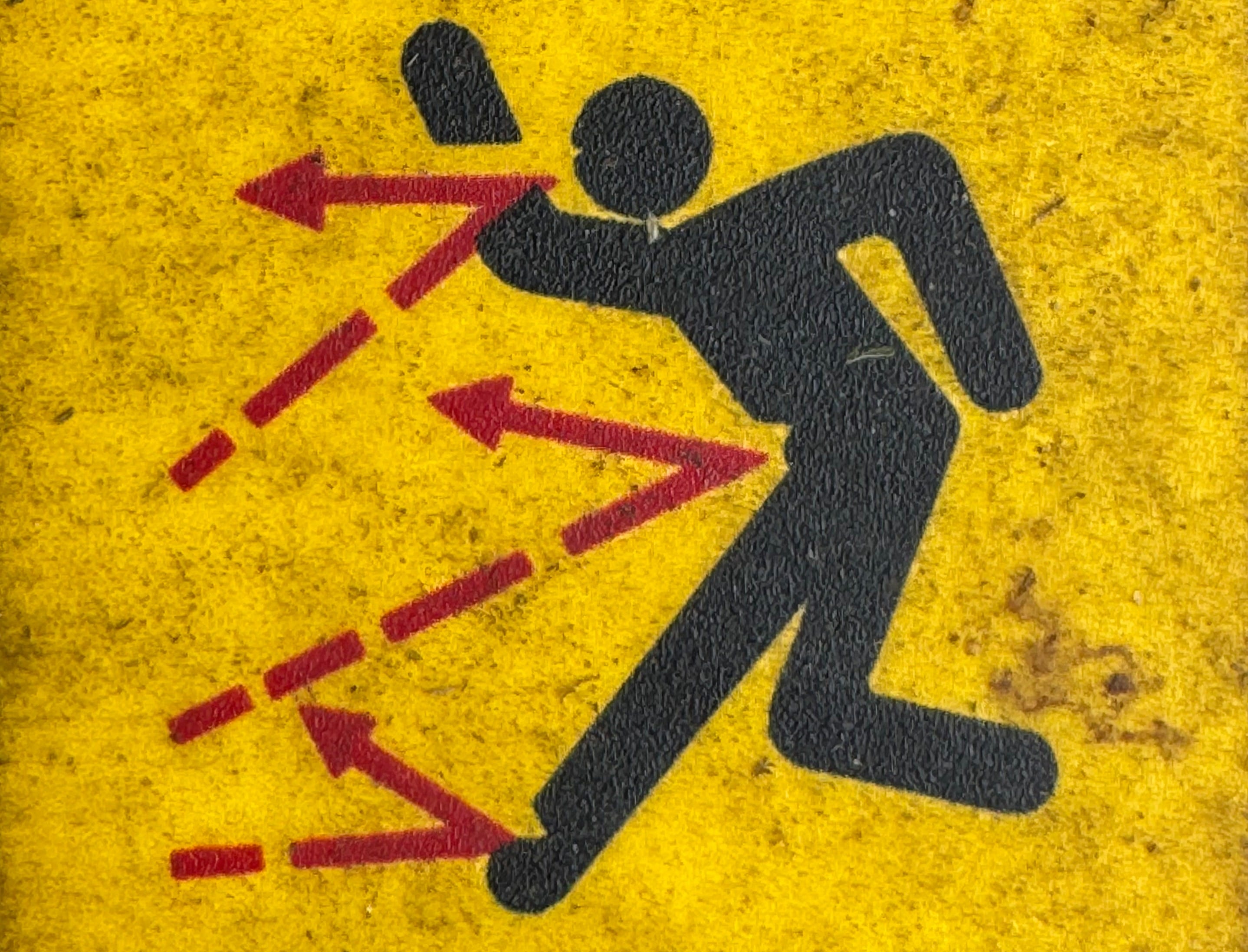
Touch grass. When you’ve given up, the easiest way to end it all is to step onto the grass. So I will take one more step, joining all those who touched grass before me.
Step. I hear the buzz of the turrets one last time. bzzzddttt
I’m struck in the arm and stagger to the ground, landing on concrete, nearly hitting my head. I’m not on the grass. A man holds my arm. He was the one who yanked me back.
I look into his dark eyes. He smiles and says, “Hey, Compa, now’s not the time to give up. Now is the time to fight.”
In his hand he holds a scythe—a tool which no one in the towers would be familiar with. They took our guns because we could not afford them. They took our machines because we could not afford them. But they left the old tools to dig ditches, dig latrines, build shacks. A scythe is a cruel joke because we have no grass to cut.
I just now notice that other people are lined up at the edge of the concrete, toes barely outside the grass. They all hold hand tools, waiting for something.
He points at the turret pillars. “Why have friends in high places, when you can have friends in low ones?”
I watch a turret train its barrels straight at me. This is finally it. I’m ready. But the turret slowly rotates toward the inner field.
bzzzddttt
                        bzzzddttt
                                                bzzzddttt
The tower dwellers playing in the grass are mowed down by the fire from dozens of turrets. I consider if I should feel sorry for them, but I feel nothing.
bzzzddttt
                        bzzzddttt
                                                bzzzddttt
The people of the outer ring rush the field, the turrets avoiding them. Why aren’t they shooting the ring folk?
I remember the chip. All of us who are slaves to money have one embedded in our wrists to track our value. The same chip that is used to track our location. The same chip that can be used by AI to avoid hitting us.
bzzzddttt
                        bzzzddttt
                                                bzzzddttt
The tech oligarchs didn’t know shit about code. They did not write it. It was the hundreds of thousands of software engineers that created the AI. They weren’t brethren. Just more workers—more chaff from the wheat. The tech oligarchs forgot who could reprogram their AI.
bzzzddttt
                        bzzzddttt
                                                bzzzddttt
The ring folk jump into the personal drone transports the billionaires didn’t bother to secure. They fly to the towers and pour out, a lethal horde.
The man hands me his scythe. “Time to mow them down.”
I take it, raise it high, and step into the field, ready to reap.
Author’s Notes
This story was from a prompt idea that RM Greta, Nick Buchheit, Nav Rao, and I talked about last October. I wrote it then, but never got around to editing it. Posting it this week seemed like the right time to express how I’m feeling.
I “wrote” this story by speaking as the character into Voice Memos on my phone on a long drive, then transcribing it. The end result is very close to what I originally recorded with edits to remove way too many “um”s. I was quite surprised that I got a story by speaking it aloud first. Maybe I’ll write more things that way in the future.
What worked well for me was the dawning realisation of that all those "bzzzddttts" were about, and the significance of the grass and the line to reach it. The inversion of what "touching grass" means in this cullture is the kind of twist that I really love.
The emotional reality of feeling like the world is entirely “owned” made this future easy to picture. I think that it could be worth it if you chose to expand this. I’d be interested to know more about day to day life and how the revolution got off the ground.
Also touch grass turning into kys is darkly funny